
Why Innovations Fail: The Science of Decision Drift
Executive Summary
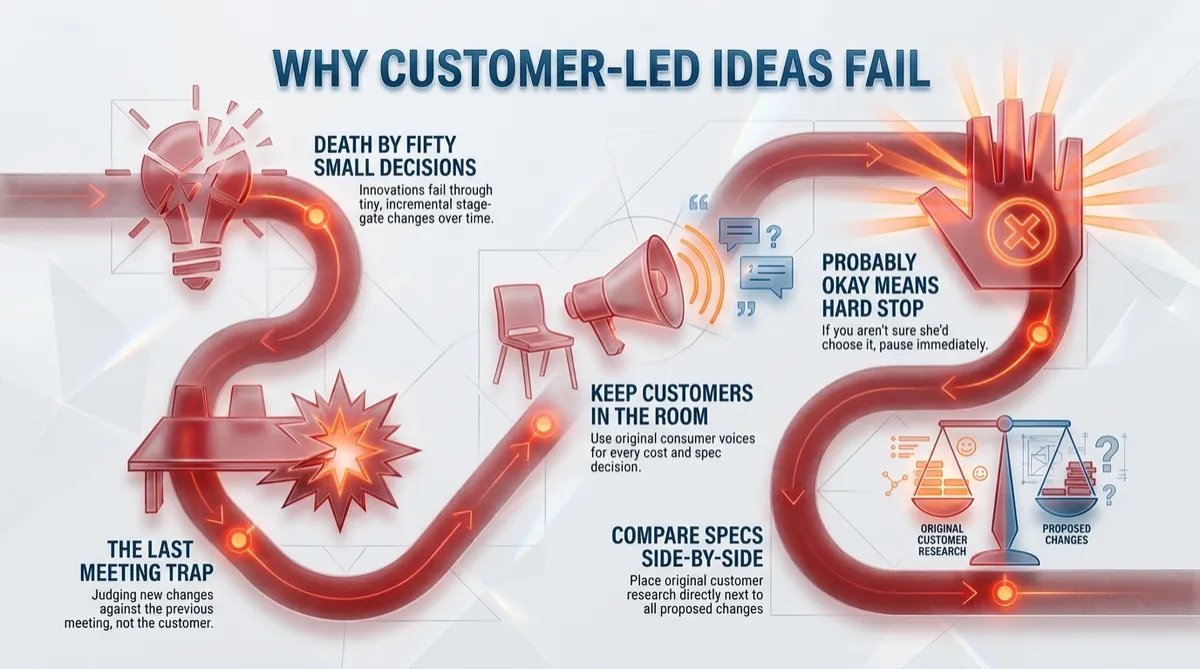
Most highly researched product failures are self-inflicted: Innovations rarely fail because the initial market research was wrong. They fail because cross-functional teams unknowingly compromise the core consumer need through dozens of minor internal modifications prior to launch.
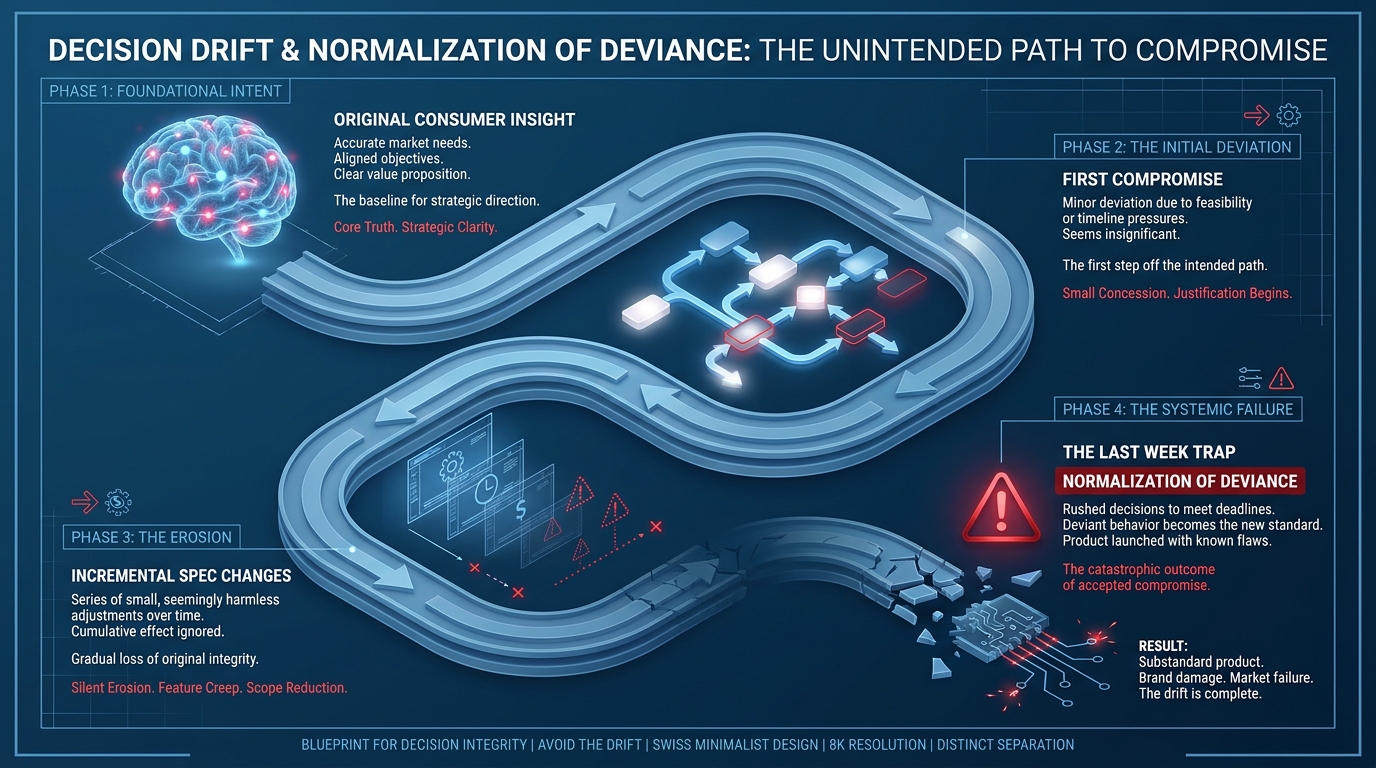
The baseline for internal decisions drifts automatically: Corporate teams naturally fall victim to the "normalization of deviance," where each new product modification is judged against the previous meeting's consensus rather than the original consumer insight.
Customer advocacy must survive the stage gates: The customer's voice cannot just be the starting point of an innovation. Effective marketing requires bringing the original consumer behavioral drivers directly into finance, operations, and R&D meetings to anchor cost-cutting decisions.
Memory drift is the ultimate warning sign of product failure: If your internal teams cannot cite the exact emotional or psychological reason a specific product feature exists, your innovation has already drifted off course. Using tools like Decision Landscapes®—Mindstate Group's proprietary framework that maps the exact emotional and cognitive triggers driving a purchase—prevents teams from losing sight of the core directive.
Hesitation indicates a loss of behavioral alignment: When evaluating a spec change, if the internal consensus is that the adjustment is "probably okay," you have lost behavioral alignment. Compromising on "probably" yields short-term margin savings at the direct expense of top-line revenue.
The Strategic Shift
You know the exact feeling.
You run the research. You find the deep human truth. You design a concept that perfectly meets your target consumer's underlying need. You put it through testing, and the data lights up.
Seventy-nine percent of people say they are absolutely going to buy your new product. You feel unstoppable.
Then you launch. And two percent of people actually buy it.
The immediate reaction is to blame the market. You blame the timing. You blame the media spend. You might even blame the research.
You're blaming the wrong things.
The old way of launching products assumes that if you start with the customer, you end with the customer. That is a dangerous illusion. You start with the customer, but then your idea enters the corporate machine.
Your perfect, customer-led concept moves from ideation into finance. They need to trim the specs to hit a margin target. It moves to operations. They have to modify the build to fit an existing assembly line because of a tight deadline. It goes to R&D. They alter the technology based on a new patent they want to use. Legal steps in and waters down your core claim.
"Innovations don't die in one meeting or even just one decision. They die in about 50 small decisions." — Will Leach.
By the time you launch, you are not selling the product 79% of people wanted. You are selling a compromised ghost of that product. Your innovation didn't fail because the market shifted. It failed because you allowed internal convenience to override behavioral science.
The Core Philosophy
To understand why this happens, you have to understand a concept from sociology called the normalization of deviance.
The normalization of deviance occurs when people within an organization become so accustomed to a deviation from standard practice that they no longer consider it deviant.
The concept was coined by sociologist Diane Vaughan when she investigated the Challenger space shuttle disaster. NASA engineers knew their O-rings weren't supposed to take any damage. But after one launch, they noticed a little scraping. Nothing bad happened. After the next launch, a little more scraping. Still, nothing catastrophic happened.
Over time, they changed their internal specifications. They normalized the wear and tear. They convinced themselves that a little degradation was perfectly fine. Until a cold Florida morning proved them fatally wrong.
This exact psychological trap happens in your product development meetings every single week.
We call it the "Last Week Trap."
When you sit in a stage-gate meeting and agree to swap out a premium material for a cheaper alternative, you aren't judging that change against the original consumer insight. You're judging it against what you agreed to in the room last week.
Your brain only recognizes the distance from step four to step five. It completely ignores the massive chasm between step one and step five. Every incremental change feels reasonable in the moment.
"Your customer has to be not just the starting point, she has to be the reference point for every decision all the way to launch." — Will Leach.
If you want to stop this drift, you have to fundamentally change who gets a seat at the table during operational meetings.
The Implementation Blueprint
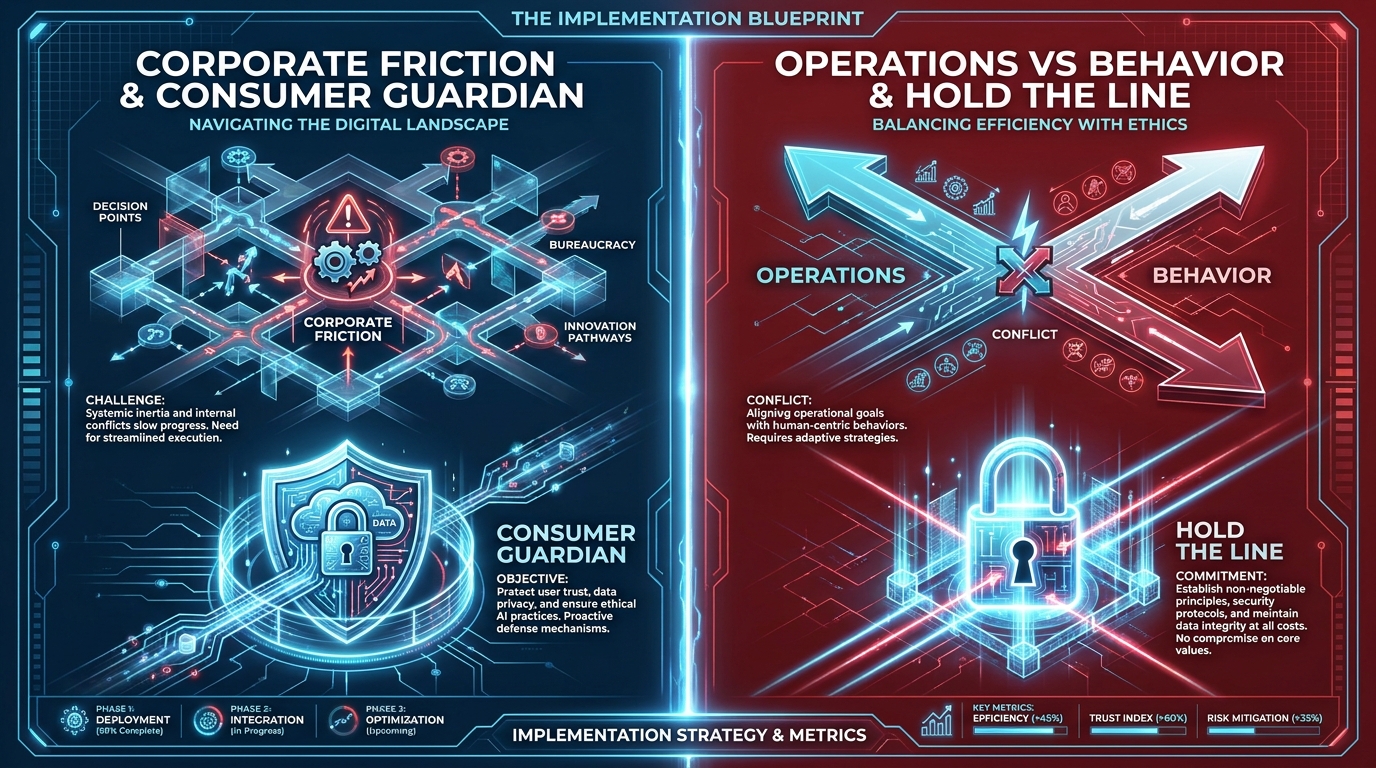
Changing this dynamic is uncomfortable. It means slowing down meetings that are designed to move fast. It means creating friction where operations and finance want compliance.
But you are the marketer. You are the guardian of the consumer's behavior. If you don't hold the line, no one will.
Step 1: Force the Side-by-Side Anchor Test
Right now, your teams review proposed changes in a vacuum. A spreadsheet shows cost savings, and everyone nods.
You have to break this visual habit. Before you approve any change to cost, timing, or scope, you must physically put the proposed change next to the original consumer research.
Take the raw insights from your Behavioral Discoveries®—our qualitative research methodology that uncovers the subconscious emotional drivers behind consumer choice—and place them literally side-by-side with the new spec sheet.
If the finance team wants to remove a specific color option to save money, read the original research aloud. Did the consumer care about that color? Was that color an emotional trigger that signaled premium status?
If there is a discrepancy between the new spec and the core human truth, you stop the meeting. It does not matter how small the discrepancy is today. It matters that this discrepancy will multiply over the next ten meetings.
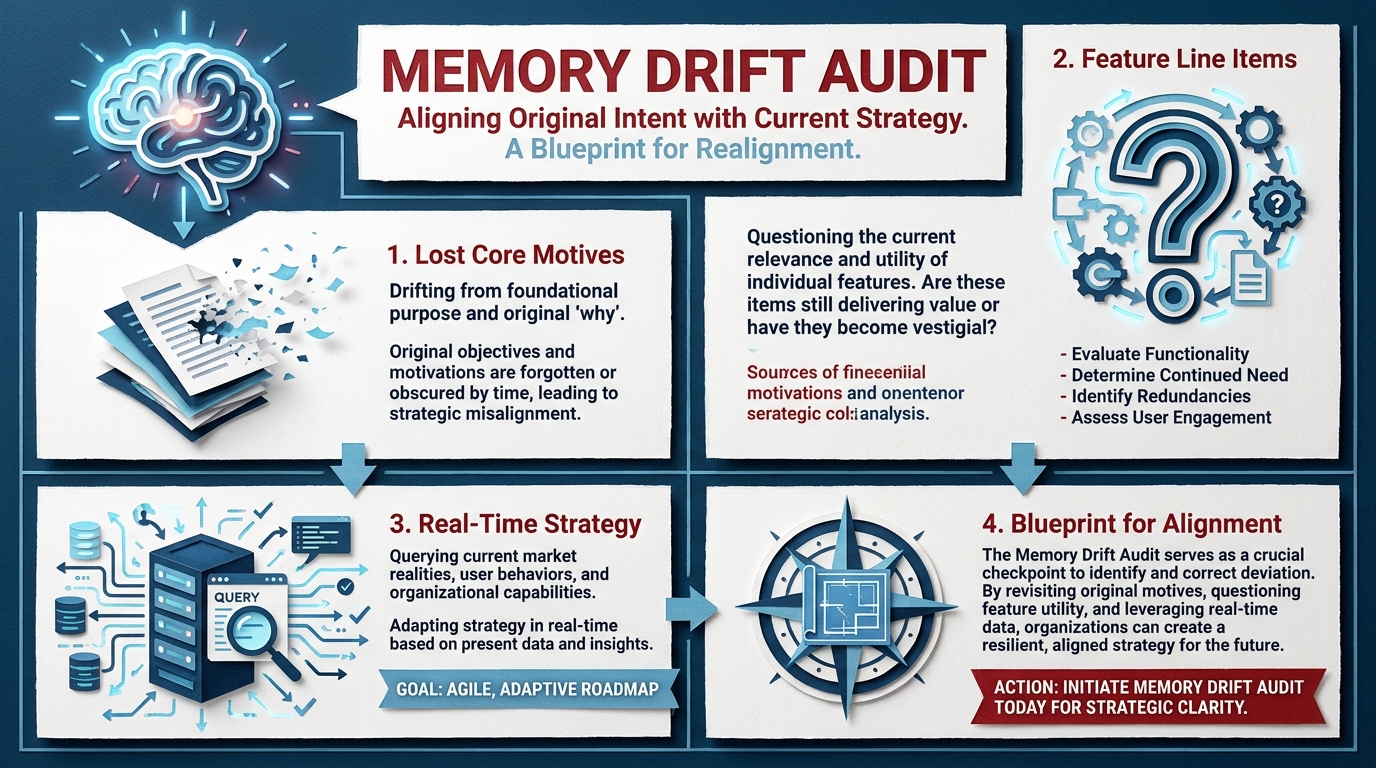
Step 2: Run the Memory Drift Audit
You can measure how far your product has drifted by testing the memories of the people building it.
In your next cross-functional meeting, point to a specific feature that is actively being modified. Ask the room, "Can anyone tell me the original consumer insight driving this specific feature?"
If the room goes quiet, you are in trouble.
When no one can articulate the behavioral reason a feature exists, that feature becomes nothing more than a line item. And line items are easy to cut.
You can prevent this by integrating the Bevi AI assistant—our proprietary AI tool that acts as a real-time behavioral strategist—into your workflow. When a spec change is proposed, you can instantly query the original behavioral parameters to remind the room exactly why a feature matters to the subconscious mind of your buyer.
Keep the original stakes front and center. Never let the team forget why they are building the thing in the first place.
Step 3: Enforce the Anti-Probably Rule
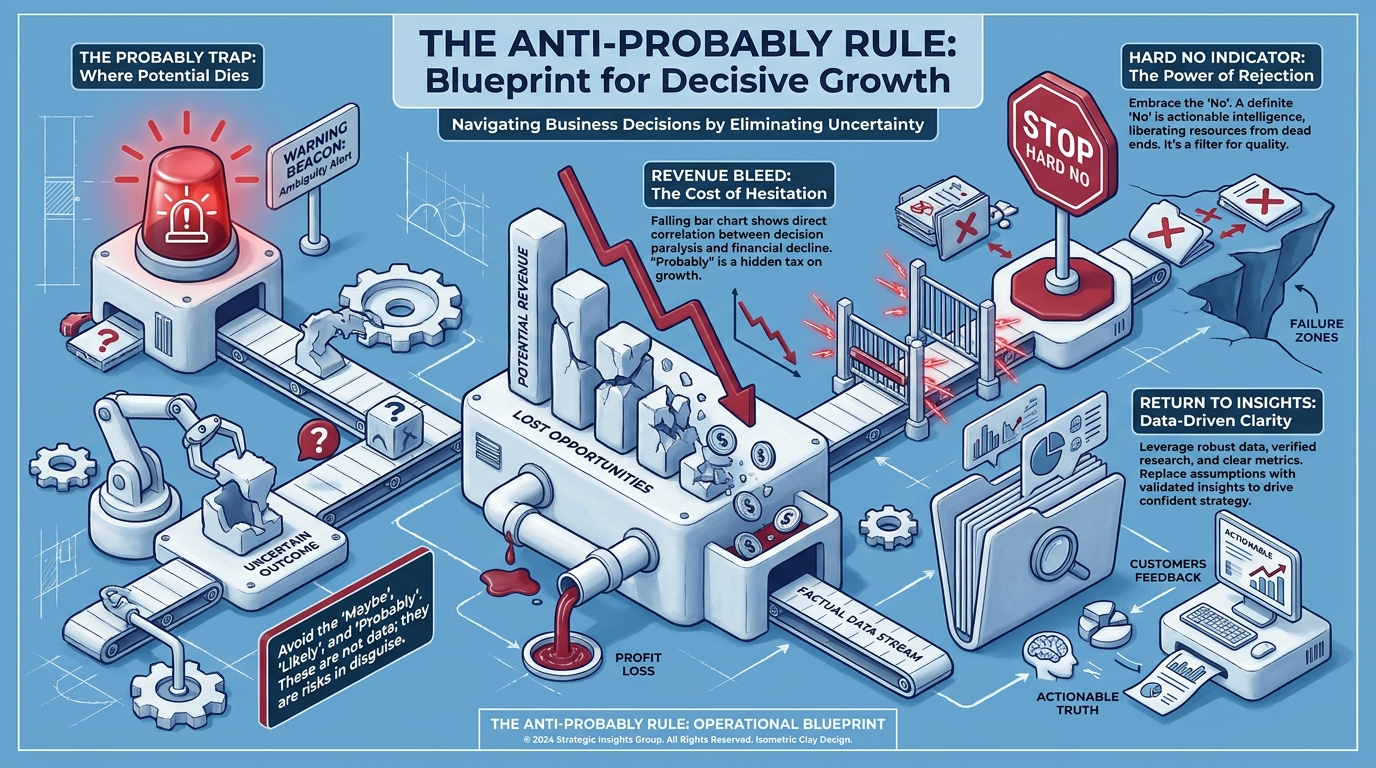
Listen to the language used in your stage-gate meetings.
When a change is proposed, someone will inevitably ask if the customer will still buy it. And someone else—usually an engineer or an accountant—will shrug and say, "Yeah, it's probably okay."
"Probably" is the sound of your top-line revenue bleeding out.
"Her voice belongs in the room when you're going to cut those costs, not just the room in the very beginning when you come up with the idea." — Will Leach.
The moment you hear the word probably, treat it as a hard no. It is a massive red flag indicating that internal assumptions have officially replaced consumer data.
If you are not absolutely positive that the customer will still choose your product after the modification, you must pause. Go back to the research. You might win a short-term victory by saving a few cents on manufacturing. But you will lose the war when the product rots on the shelf.
Inside the Live Session
If you want to see what this looks like when the stakes are massive, look at the auto industry. Look at the Pontiac Aztek.
In the mid-1990s, General Motors found a brilliant consumer need. Young, active buyers wanted a vehicle that could handle camping and off-roading, but didn't want a standard minivan.
GM did the research. They created a phenomenal concept car called the Bear Claw. It was essentially a Camaro mashed up with a Blazer. It was aggressive. It had attitude. The target market loved it.
Then the Bear Claw went into the corporate blender.
Accountants demanded cost cuts, so they forced the car onto an existing minivan platform. That made the vehicle bizarrely tall, short, and narrow. Manufacturing constraints forced them to use cheap plastic cladding instead of real steel. Over months of meetings, hundreds of small, totally rational corporate decisions stripped the soul entirely out of the vehicle.
They launched the Aztek in 1999. The critics didn't mind the souped-up floor model, but actual consumers laughed at it. GM forecasted 75,000 units. Their break-even was 30,000. In their absolute best year, they barely moved 27,000 cars. A top GM executive later admitted they couldn't even give the things away.
I watched this exact same tragedy play out a few years ago with a client in the pest control space.
They had a life-or-death product. It was designed to solve a critical pest problem in developing countries. They found the deep consumer need. They nailed the initial concept.
Then they let it drift. R&D made tweaks. Sales adjusted the parameters. Finance cut the quality of the materials.
A year later, they launched. They captured only 30% of the market share they forecasted. It was a brutal, expensive loss.
Two years after that failure, they brought us in to figure out what went wrong. We mapped their launch product against their original research using the Mindstate Activation Blueprint—our step-by-step system for ensuring brand executions align perfectly with subconscious consumer desires.
The answer was painfully simple. They built a product for their own internal departments, not for the end user. They couldn't see the drift because they never looked at the whole timeline. They only looked at the changes week to week.
If you want to watch a breakdown of exactly how to guard against this in your own organization, you need to watch this entire masterclass session.
The Behavioral Imperative
Your competitors are sitting in stage-gate meetings right now, slowly compromising their best ideas to death.
They are cutting corners because it's easy. They are letting finance dictate product strategy because they don't have the behavioral science to push back. They are building products that are "probably okay."
You don't have to play that game.
You can be the marketer who anchors every single operational decision to a psychological truth. You can be the one who stops the meeting, pulls up the original research, and forces your company to build what the consumer actually desires.
Are you going to let your next innovation die by fifty small cuts, or are you going to put the customer's voice back in the room where it belongs?