
The Identity Protocol: Why Brands Lose to $800 Cowboy Boots
The Identity Protocol: Why Your Brand Is Losing to $800 Cowboy Boots
Why functional marketing fails to capture market share: Consumers do not evaluate brands based solely on product features; they use fast, intuitive mental processing to select brands that align with their subconscious psychological goals.
Why emotional marketing is no longer a competitive advantage: Generative AI has made identifying and messaging consumer emotions cheap and ubiquitous, reducing emotional connection from a differentiator to mere table stakes.
What actually drives high-ticket consumer purchases: People do not buy brands; they buy the aspirational identities those brands allow them to adopt in their daily lives.
How to uncover a buyer's aspirational identity: You must utilize a sequential three-step interview protocol to force the consumer past functional features and temporary emotional states directly into their ultimate self-concept.
The Strategic Shift
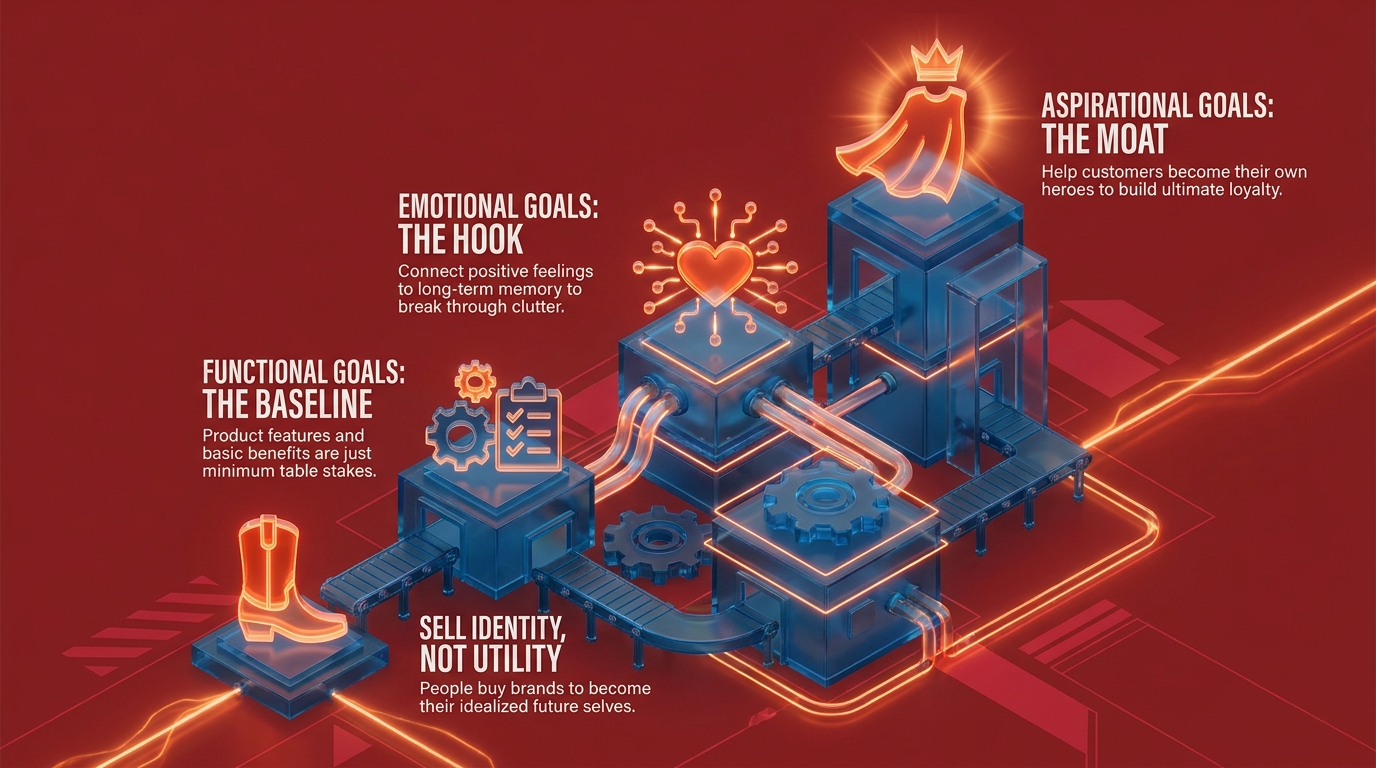
I sat in Terminal D at Dallas Fort Worth airport last week and watched hundreds of business executives walk off flights wearing $800 cowboy boots. These are people carrying corporate laptops and designer carry-ons. Half of them have never been on a horse. They aren't working cattle. They aren't running ranches.
So why is a software sales executive dropping eight hundred dollars on footwear designed for manual agricultural labor?
If you ask traditional marketers, they will point to the leather quality, the stitching, or the durability. They will look at the functional attributes of the boot. And they will be completely wrong.
The traditional way of marketing operates on a flawed assumption. It assumes buyers make rational calculations about features and benefits. The Mindstate Group alternative recognizes a fundamental truth of behavioral psychology: people do not buy brands. They buy identities.
Over the decades, the concept of the cowboy transitioned from a literal profession into a psychological identity. The cowboy represents independence. Capability. Toughness. The unyielding American spirit. When an executive pulls on a pair of premium boots in the morning, they are not putting on comfortable footwear. They are putting on an identity. They are signaling to the world—and to themselves—who they are.
You are likely making a massive mistake in your marketing right now. You are selling the leather. You need to be selling the cowboy.
The Core Philosophy
We are all on a continuous, subconscious quest to become different versions of ourselves. Some of your customers invest in luxury cars because they want the identity of a successful elite. Others invest heavily in nonfiction books and courses because they want the identity of an intellectual.
In behavioral psychology, this is known as goal pursuit theory.
"Every single action you take, whether it is signing up for a course or buying any product, it's all towards helping you reach a psychological goal that you have." — Will Leach.
Your customers will never buy your product or service if they do not subconsciously believe it will help them reach their goals. But not all goals are created equal. They exist in a strict hierarchy. To understand this, we utilize Decision Landscapes®, a visual map showing exactly how subconscious goals, motivations, and behavioral barriers interact to drive a specific consumer choice.
When you map a consumer's mind, you realize that marketing to what they get (functional goals) or even how they feel (emotional goals) is no longer enough.
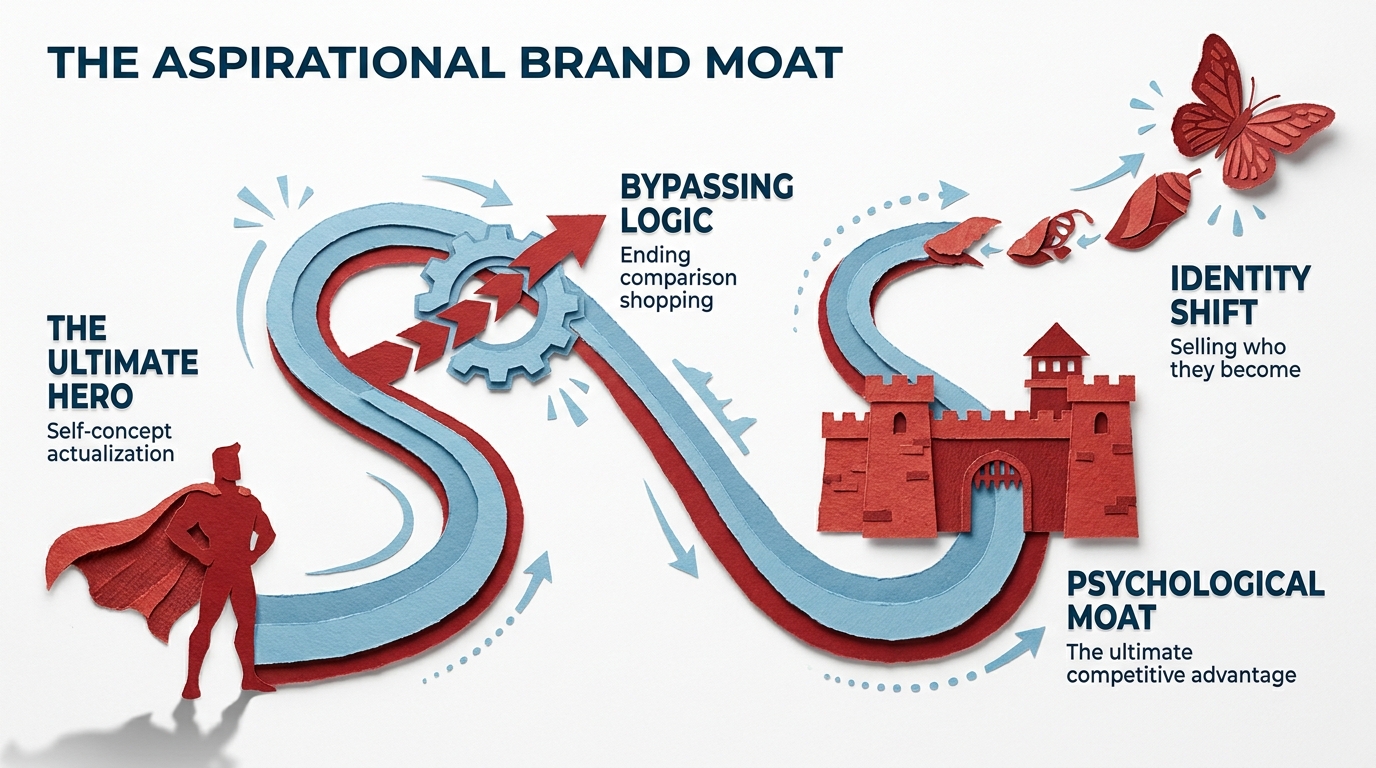
You must market to who they want to become. Aspirational goals are the final psychological moat for your brand.
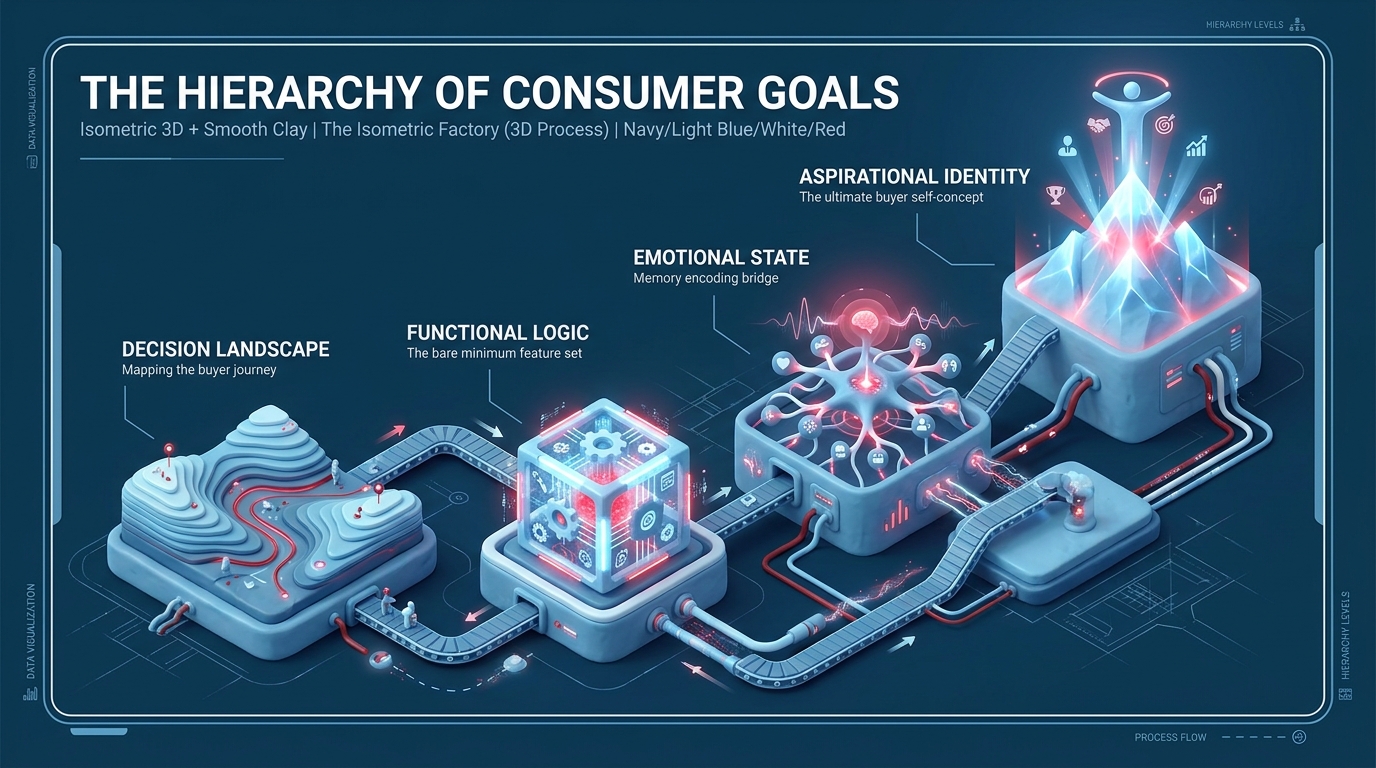
If you want to stop competing on price and features, you have to transition your messaging to target aspirational identity. This requires a complete audit of how you research and communicate with your market.
The Implementation Blueprint
To build this psychological moat, you must fundamentally change how you interview your customers. You cannot ask them why they buy and take their first answer as the truth. You have to walk them through a specific three-step protocol that uncovers the hidden drivers behind their purchase.
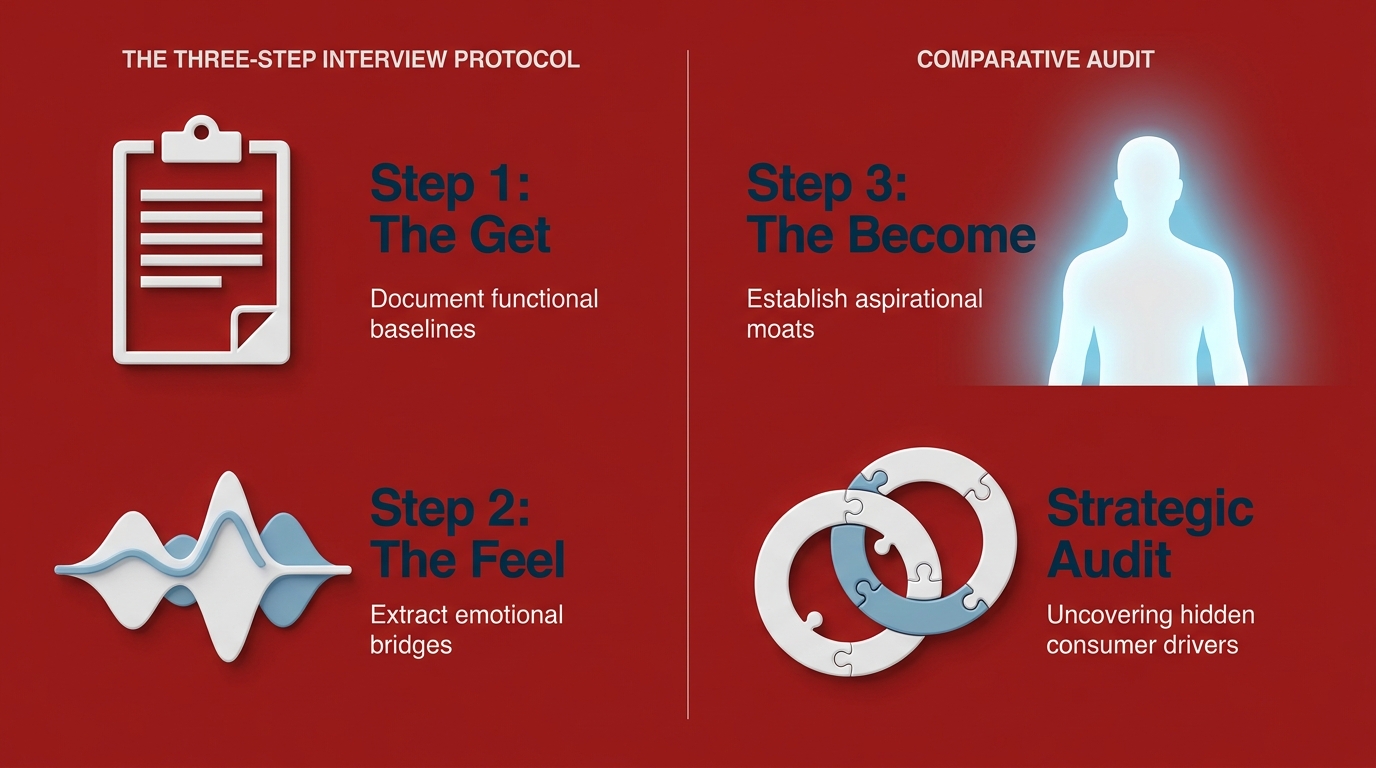
Step 1: Document the Functional Baseline (The "Get")
The Action: Sit down with your existing customers. Ask them a very specific, constrained question: What are the five most important reasons why you buy my brand?
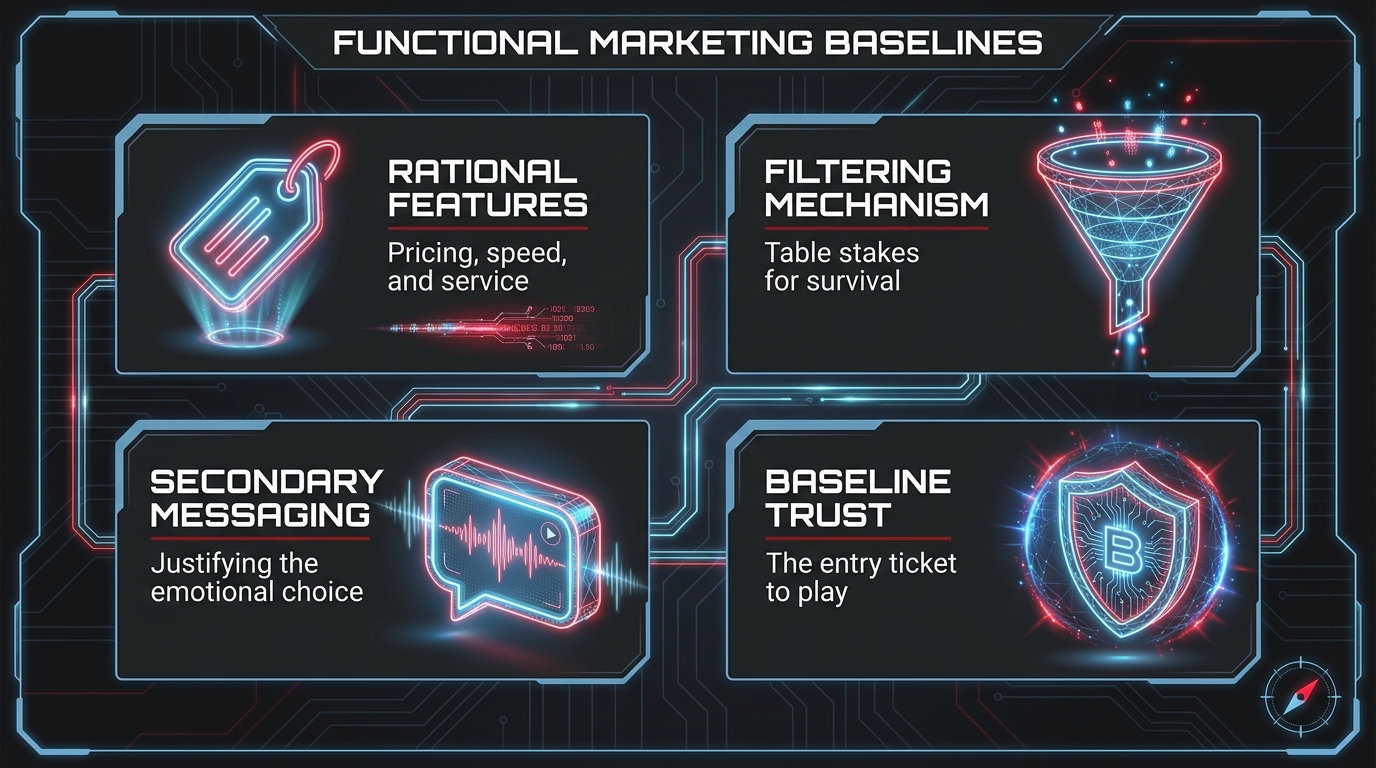
Do not ask for general feedback. Force them to list the top five concrete reasons they chose you over the competition. Write these down exactly as they say them. They will tell you about your pricing, your speed, your customer service, or your product features. These are their functional goals.
The Business ROI: You must understand functional goals because they are the bare minimum requirement to play the game. If you fail to communicate these five things in your baseline marketing, the consumer's brain will filter you out immediately.
But do not mistake table stakes for a competitive advantage. Meeting functional goals simply gets you noticed. It does not generate purchases or loyalty. You will use these five functional points as secondary messaging in your campaigns to rationally justify the emotional choice the buyer is about to make.
Step 2: Extract the Emotional Bridge (The "Feel")
The Action: Once your customer has listed their top five functional reasons, you immediately ask the second question: Collectively, if we delivered perfectly on all five of those things, how would that make you feel?
You are forcing their brain to transition from rational evaluation to emotional state. They will stop talking about speed and price. They will start using words like confident, secure, relieved, or connected. These are their higher-order emotional goals.
The Business ROI: Connecting your brand to a specific emotional goal is how you begin penetrating long-term memory. Human memory is heavily dependent on emotional encoding. If you want your brand to be remembered months from now when a buying trigger occurs, you must attach your messaging to the exact emotion your customer just named.
To do this at scale, we rely on Bevi AI, an artificial intelligence assistant trained exclusively on behavioral science to instantly generate psychologically optimized marketing copy. This ensures the precise emotional target is hit consistently across every touchpoint.
However, emotional marketing has a newly exposed vulnerability. Generative AI has made it incredibly easy for every mediocre brand in your category to identify and message emotional states. Everyone is now claiming they make their customers feel "confident" or "secure." Emotion alone will no longer break through the noise.

Step 3: Establish the Aspirational Moat (The "Become")
The Action: This is the critical final step. You have their functional features. You have their emotional state. Now, you ask the ultimate question: If you got those things, and you felt that way, what would that allow you to do differently? Who would that allow you to become?
This is where the magic happens. They will stop talking about your brand entirely. They will start describing their idealized self. They will describe the superhero version of themselves that they desperately want the world to see.
"When you associate your brand with that self-identity, that aspirational goal, that is how you create brand advocacy." — Will Leach.
The Business ROI: This is the ultimate competitive advantage. When you align your positioning statement with a customer's aspirational identity, you bypass the conscious comparison shopping process. They no longer see you as a vendor. They see you as a vehicle for their own self-actualization... and advocate on your behalf.
Once you identify this, you must rebuild your communication architecture. We structure this using the Mindstate Activation Blueprint, a step-by-step system that translates behavioral science insights into actionable marketing creative and messaging. You lead with the aspirational identity first. You follow with the emotional feeling second. You justify it with the functional features last.
Inside the Live Session
If you want to see exactly how this messaging hierarchy dictates real dollars, look at the restaurant industry. I broke this exact model down during our recent Implementation Masterclass using a personal case study.
Ever since my son Nicholas was a toddler, we have done "boys night out" every Wednesday at a local chain here in Dallas called Palio's Pizza.
If you were the CMO of Palio's Pizza and you stopped your research at Step 1, you would think I choose your restaurant because the pizza tastes great, the price is a good value, and the service is fast. That is my functional goal.
If you pushed to Step 2, you would realize I want a quiet environment so I can have a meaningful conversation with my son. I want to feel caring and thoughtful. That is my emotional goal.
But if you executed Step 3, you would uncover the real reason I drive past five other pizza places to get to Palio's. I am trying to raise my son with intention. I refuse to let him learn about life by accident. My aspirational goal has absolutely nothing to do with cheese or pepperoni. My aspirational goal is to be the thoughtful father who becomes his kid's hero.
Palio's is not selling pizza to the neighborhood. They are selling the ability for fathers to connect deeply with their kids. If Palio's built their brand messaging around helping dads become heroes, I would never eat at a competing franchise again.
The Behavioral Imperative
The most iconic, dominant brands in the world share one defining trait. They do not sell products. They sell the ability for their customers to become their very best selves.
As technology makes it easier for your competitors to replicate your features, match your pricing, and mimic your emotional marketing, identity is the only durable moat left. The brands that survive the next decade will be the ones that understand who their customers aspire to be on their very best day.
Right now, your competitors are still marketing to what consumers say they want. You can be the one who markets to who they actually want to become.
Do the audit. Run the three-step interview protocol this week. Find your $800 cowboy boot. Then rewrite your messaging to sell the hero, not the leather.