
Stop Late Ad Testing: The Behavioral AI Blueprint
Executive Summary
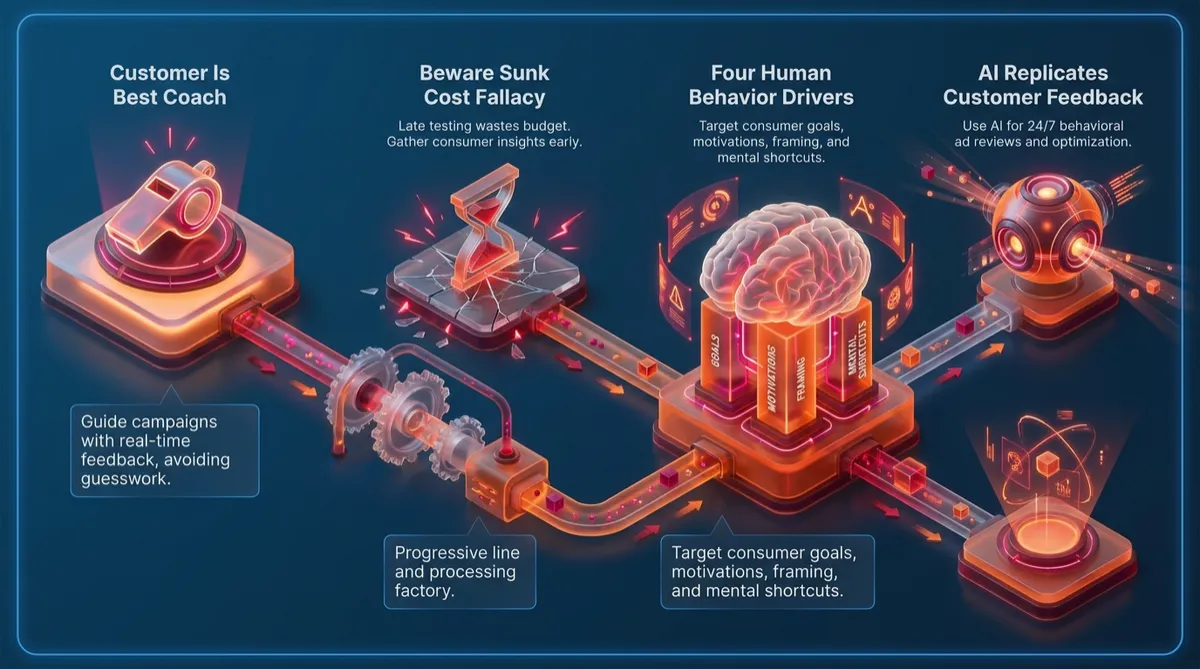
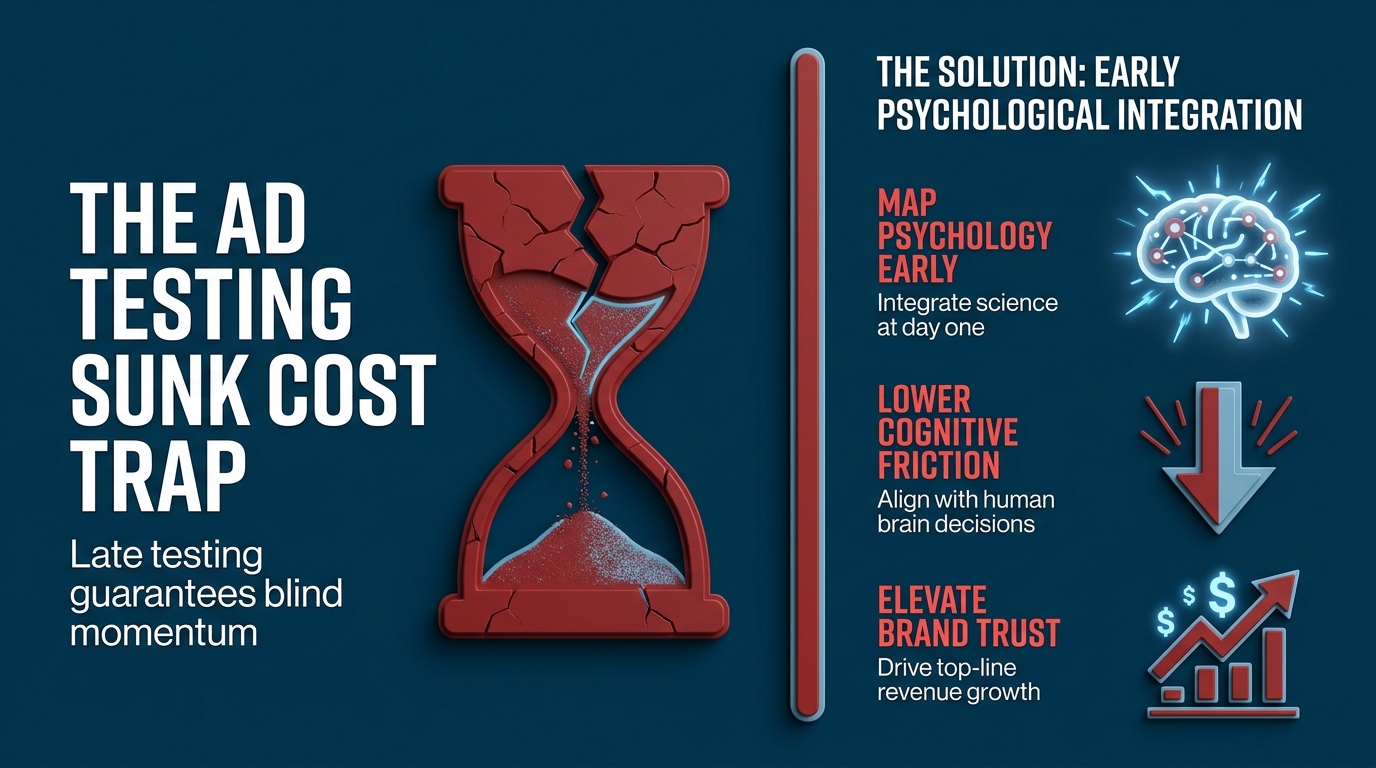
Late ad testing creates a sunk cost trap: Evaluating campaigns just days before launch virtually guarantees failure. Once time, budget, and agency approvals are invested, marketing teams become psychologically blind to critical feedback, preferring to launch flawed creative rather than scrap the project.
Your customer is the ultimate advertising authority: Relying solely on historical data or past campaign norms is dangerous. In today's fast-paced world, effective marketing requires treating your specific customer as a real-time coach who evaluates creative friction, visual cues, and messaging relevance at every single stage of development.
Behavioral drivers outweigh demographic targeting: Demographics, attitudinal, and behavioral data alone are insufficient for predicting purchase behavior. Campaign messaging must be explicitly engineered around a buyer's immediate functional goals, underlying emotional motivations, approach framing, and subconscious mental shortcuts.
Continuous behavioral mapping eliminates cognitive friction: You have to align your creative with the exact psychological state of your buyer. Using the Mindstate Activation Blueprint—a framework that matches creative messaging to the distinct psychological drivers influencing a buyer at the moment of choice—you can pressure-test concepts before a single dollar is spent on media.
AI can now replicate the consumer's psychological mindstate: You no longer need to wait for expensive, slow traditional focus groups. The Bevi AI assistant—a behavioral intelligence system that mimics your target customer's specific decision-making profile—allows resource-strapped teams to audit briefs, scripts, and visual concepts continuously.
The Strategic Shift
If you want to understand how most mid-size and large brands handle advertising today, picture a football team stuck on the field.
You are in the mix. The clock is running. The noise is deafening. You have artificial intelligence mandates hitting you from the C-suite. You have ad testing requirements. You have creative concepts flying back and forth. You are simply trying to work with what you have on the field at that exact moment to get the ball across the goal line.
You do not see the gaps opening up. You do not see the coverage shifting. You are blind to the larger board because you are reacting to the chaos right in front of you on the field.
When you run an ad campaign—let's say an in-store grocery initiative—you typically have four weeks to get it out the door. Week one is dedicated to the brief. Week two is spent reviewing and finalizing concepts. Week three is dedicated to scripts and visual renderings. Week four is final creative and launch.
In that highly compressed window, you lack the resources, people, and budget you used to have. So, what gets squeezed?
Research. Customer feedback. The actual coaching you need to win.
The old way of running marketing dictates that you skip consumer input until the very end. If you are lucky, you squeeze in testing a few days before launch. You get the results back, and the data shows there are critical flaws. But it's too late. You have to launch in five days.
Or worse, you run zero screening at all. You push the campaign live. You wait for the back-end tracking data to arrive. You find out it was the worst-performing initiative of the year, your short-term sales are destroyed, and you are sitting in a conference room having to justify the failure.
"It's kind of like this. If you are waiting until the last second to do any kind of consumer feedback, that's like getting, you know, to the end of the football game. You have two minutes left and then you're starting to think of okay now let's go make some inplay adjustments." — Will Leach
That is not strategy. That is a dangerous illusion of rigor.
Winning football teams rely on a coach or coordinator sitting high above the field in the booth. That coach sees the entire board. They make real-time adjustments throughout all four quarters. They shift protection, change the coverage, and correct small errors drive after drive. By the time the clock hits zero, those tiny, continuous corrections stack up into a win.
Your marketing requires the exact same coaching. And your best coach is not an agency creative director. It is not an industry best practice.
Your best coach is your actual customer.
The Core Philosophy
You cannot wait until the fourth quarter to ask your customer if your ad actually works.
You have to bring them into the brief. You have to bring them into the concept stage. You have to bring them into the first script read.
Why? Because of a psychological trap called the sunk cost effect.
When you wait until the end of the process to gather feedback, you have already created unstoppable momentum in one direction. You have already paid the agency. You have already secured sign-off from your VP. You have already spent your budget.
"You've already paid the ad agency. You've already put in the time. You've already got approvals from your vice president. So, what you'll happen is is that when evidence comes up, maybe somebody else's opinion and they're saying, 'I'm not sure if this is the right thing to do.' You're going to be blind to that, right? because you're going to defend what's already been paid for…" — Will Leach
It is exactly like sitting through a terrible movie. You know thirty minutes in that the movie is awful. But you sit there anyway. You already bought the ticket. You already paid for the popcorn. You defend your decision to stay because of the sunk costs.
In marketing, this bias is catastrophic. It causes you to ignore valid criticism and defend mediocre creative simply because it is already built.
To break this cycle, you must map your creative against behavioral science from day one. You have to evaluate every single line of copy and every visual rendering through the lens of human psychology.
The Mindstate Group approach demands that you stop marketing to demographic profiles and start marketing to the psychological mindstate of your buyer. We use the Mindstate Activation Blueprint—a proprietary framework that aligns your creative messaging with the exact functional goals, emotional motivations, approach framing, and cognitive shortcuts influencing your buyer at the moment of purchase.
When you align your marketing to how the human brain actually makes decisions, you lower cognitive friction. You elevate trust. You drive top-line revenue growth.
The Implementation Blueprint
To successfully get your customer "in the booth" to coach your advertising, you must evaluate your creative at every stage against four core behavioral drivers.
If your ad misses even one of these, you are introducing friction.
Step 1: Target the Functional Goal
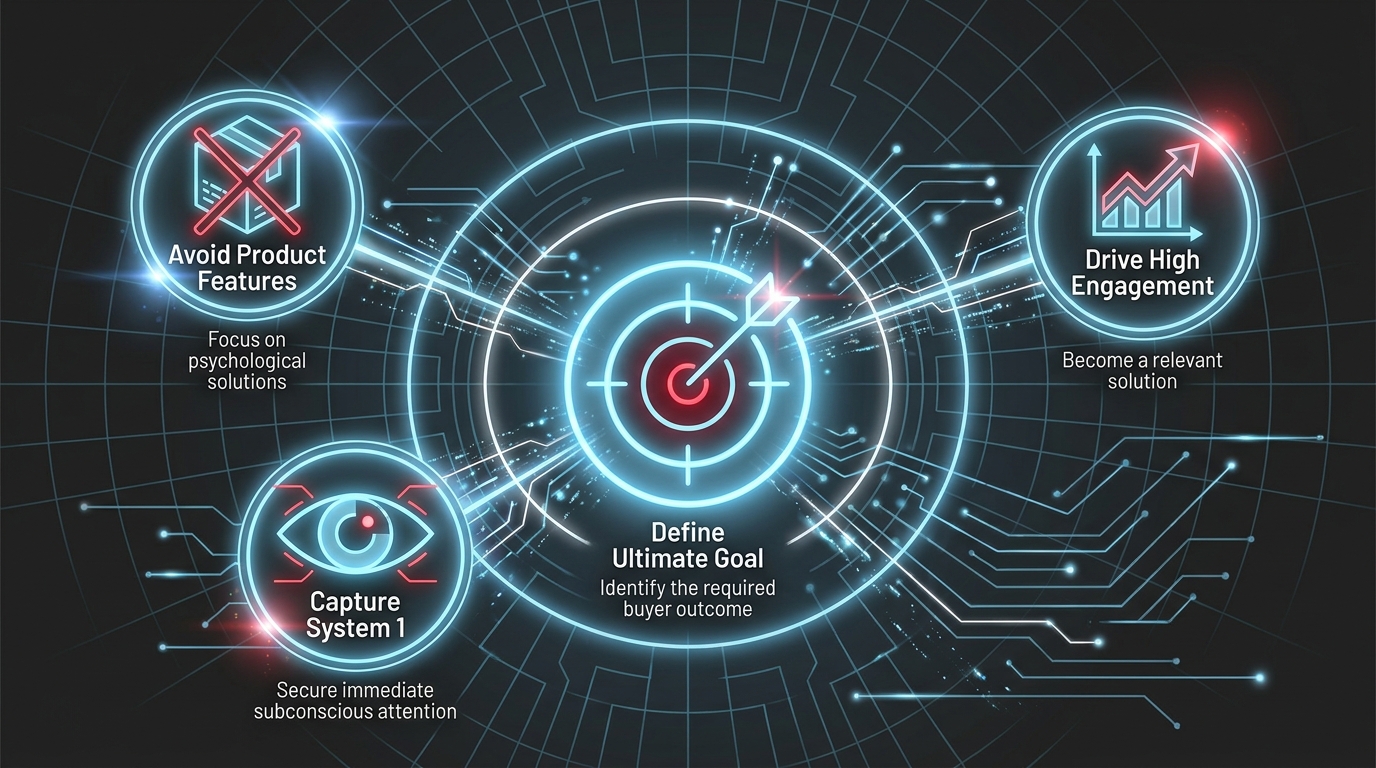
Before you write a single headline, you must identify the exact goal your customer is trying to achieve when buying your product.
This sounds basic. It is not. Most marketers build ads around what the product does, rather than the specific outcome the consumer requires in that exact moment. You have to review your brief and ask: Does this creative directly communicate the ultimate goal she wants to reach?
Action: Pull your current campaign brief. Read it line by line. Highlight the sections where you explicitly state the customer's functional or emotional goal. If you are only talking about your brand's features, you have a gap.
Business ROI: By clearly addressing the consumer's functional goal, you immediately capture System 1 attention. Your ad stops being an interruption and becomes a relevant solution, driving higher initial engagement metrics.
Step 2: Prime the Core Motivation
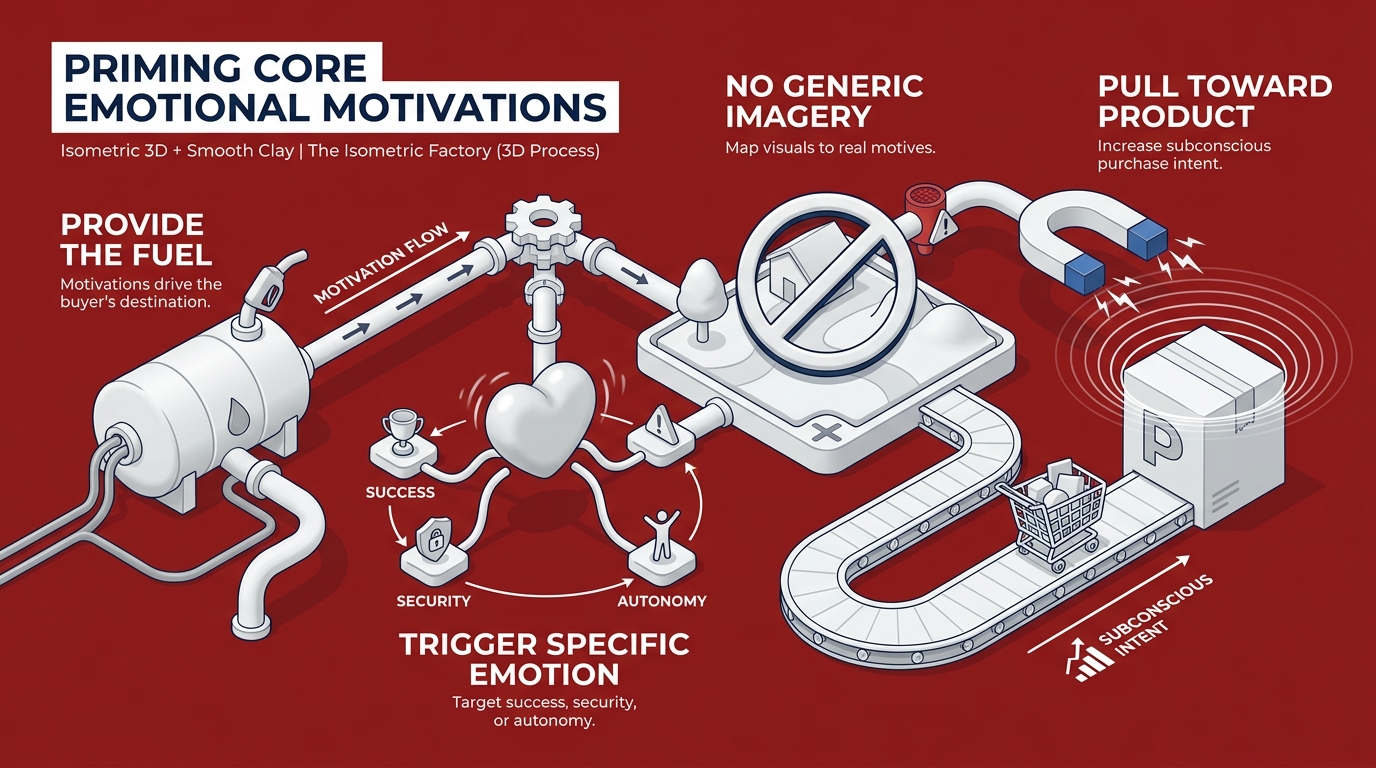
Goals give your customer a destination. Motivations provide the fuel to get there.
You need to know what feelings your buyer wants to experience when engaging with your brand. Do they want to feel successful? Secure? Connected? Autonomous? You must prime these core emotional motivations visually and textually in your ad.
Action: Review your visual concepts and scripts. Ask your team: What specific emotion are we triggering here? Does this imagery map to the motivation our buyer actually cares about, or are we just using generic, happy stock photography?
Business ROI: Emotion drives action. When you prime the correct underlying motivation, you increase the likelihood of conversion because the buyer feels an intuitive, subconscious pull toward your product.
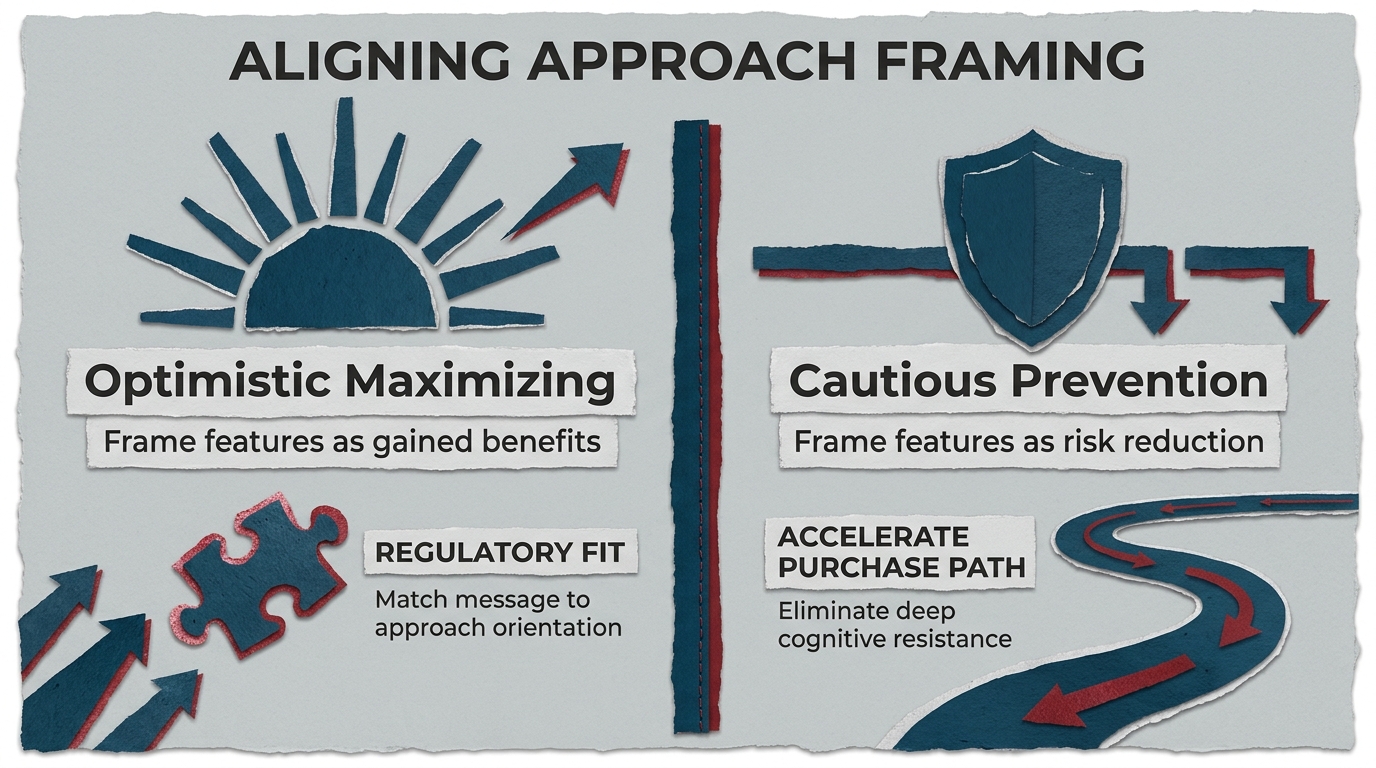
Step 3: Align the Approach Framing
This is where most creative falls apart. How does your customer want to pursue their goal?
Are they operating optimistically, seeking to maximize good things and gain a benefit? Or are they operating cautiously, seeking to avoid risk and prevent a negative outcome?
How you frame your copy changes dramatically based on this psychological approach. If your customer is in a cautious, prevention-focused mindstate, and your ad promises "exciting new possibilities," you will trigger cognitive resistance. They want safety. You are selling thrill. The ad will fail.
"What I want you to do is not wait until the fourth period or the fourth quarter, right? I want you to start thinking about how do we get our coaching in the beginning of the ad process in the third first quarter, the second quarter, the third quarter." — Will Leach
Action: Audit your ad copy. If your buyer's mindstate is optimistic, ensure your features are framed as gains. If their mindstate is cautious, reframe those exact same features as risk-reduction mechanisms.
Business ROI: Proper framing creates "regulatory fit." When a message matches a buyer's approach orientation, the decision feels naturally right. This eliminates cognitive friction and accelerates the path to purchase.
Step 4: Trigger the Right Mental Shortcuts
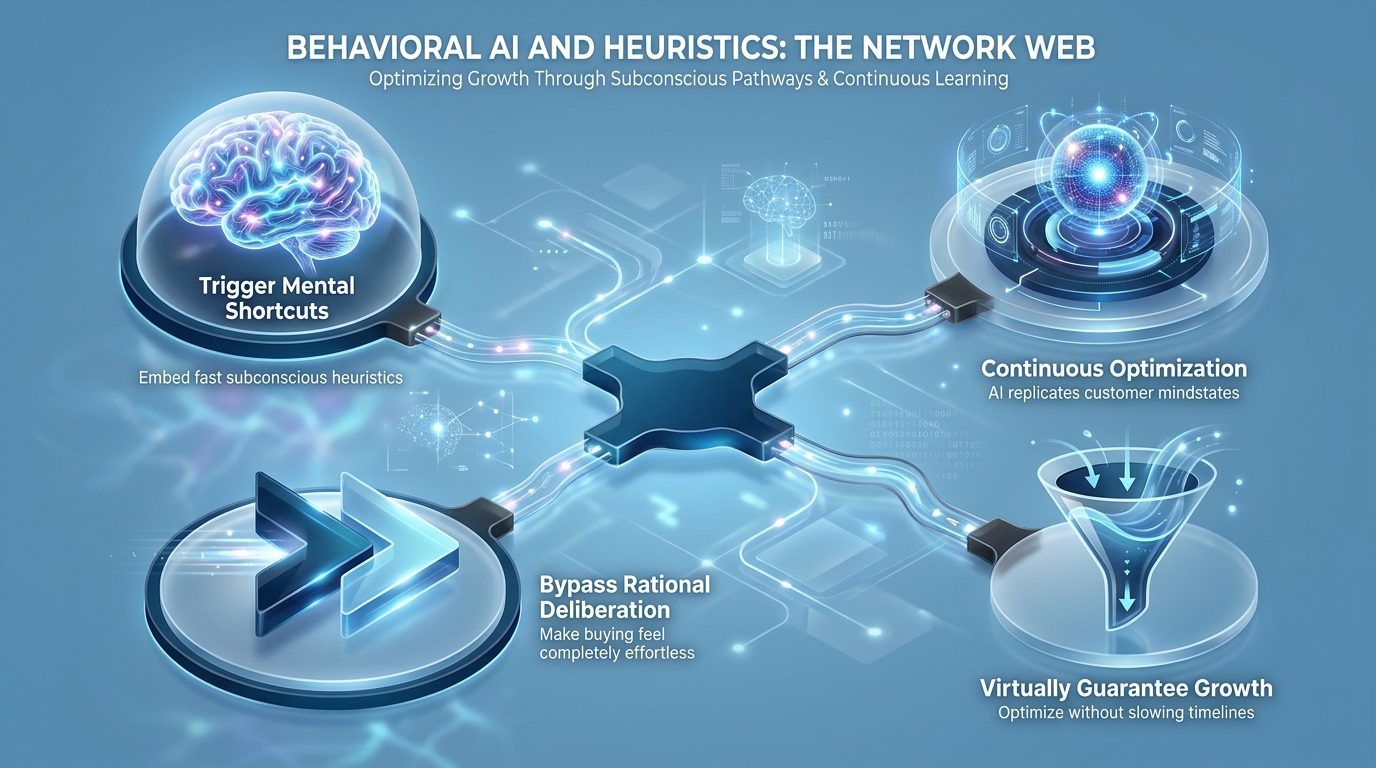
Humans rely on heuristics—subconscious mental shortcuts—to make fast decisions without expending unnecessary energy.
There are around 21 primary cognitive heuristics detailed in my book, Marketing to Mindstates. You must actively design these triggers into your marketing. Are you using social proof to validate the choice? Are you utilizing the decoy effect to make your premium tier look more attractive? Are you using hyperbolic discounting to drive immediate action?
Action: Examine your final visual layouts. Identify precisely which mental shortcut you are triggering to help the consumer make a fast, easy decision. If you cannot name the heuristic, your ad is forcing the customer to think too hard.
Business ROI: By intentionally embedding behavioral triggers, you bypass heavy rational deliberation. You make the act of buying feel effortless, which directly increases conversion rates at the point of sale.
Step 5: Override the System with Behavioral AI
You know you need your customer in the room at every step. You also know that running traditional research during week one, week two, and week three of a tight sprint is impossible. It costs too much. It takes too long.
Here is the system override. You no longer need to rely on human focus groups to get behavioral feedback.
You can use the Bevi AI assistant—Mindstate Group's behavioral AI platform that replicates your specific customer’s psychological profile to review and optimize creative assets at every stage of development.
"With artificial intelligence, you can have your customer in every single review you ever do. You can have your customer in your meeting every day." — Will Leach
Action: Feed your early-stage briefs, scripts, and visual concepts into a behavioral intelligence tool like Bevi. Ask the AI to analyze the work specifically through the lens of your target's psychological mindstate. The system will identify friction points, tell you where the message misaligns with their motivations, and actually tweak the copy to match their decision-making process.
Business ROI: You get continuous, real-time creative optimization without slowing down your timeline. By the time you launch, you have engineered the ad to succeed at a psychological level, virtually guaranteeing top-line sales growth.
Inside the Live Session
Let me show you what happens when you ignore this process.
A client of mine runs a product that sits in the middle of the grocery store. Every year, they run a massive back-to-school campaign featuring perimeter displays.
Recently, time got tight. The team was stressed. They lacked resources. Instead of pausing to understand their buyer's current psychological mindstate, they defaulted to what worked in the past. They slapped a yellow school bus on a cardboard display, added some photos of cheering kids, stocked the product, and shipped it.
They did no testing. They did no behavioral alignment. They pushed it all the way through because they had to hit a deadline.
It was the worst-performing back-to-school campaign they had run in years.
Why? Because they didn't have their customer in the booth coaching them. They relied on an illusion of rigor—the false belief that because a tactic worked three years ago, it would magically work today. Consumer psychology shifts. If you are not mapping those shifts in real-time through an Implementation Masterclass approach to your creative, you are throwing budget into a black hole.
You can watch this exact methodology deployed in real-time. Review the full masterclass session to see how we take generic ad copy and scientifically optimize it for emotional resonance and reduced friction.
The Behavioral Imperative
The standard model of ad testing is broken. Waiting until the final edit to ask if an ad works is a recipe for stalled growth and wasted budgets.
Your competitors are still operating down on the field. They are still caught in the chaos, reacting to tight deadlines, and relying on last-minute post-testing to justify their creative decisions.
You can step into the booth. You can implement continuous behavioral coaching from day one. You can map your messaging to actual human goals, motivations, and mental shortcuts.
Here is your challenge for Monday morning: Pull the ad campaign you are currently building. Do not wait for the final tracking data. Look at the script right now and pinpoint exactly which subconscious mindstate you are targeting. If you cannot name it, stop the production process. Bring your customer back into the room, and do not launch until the psychology aligns.