
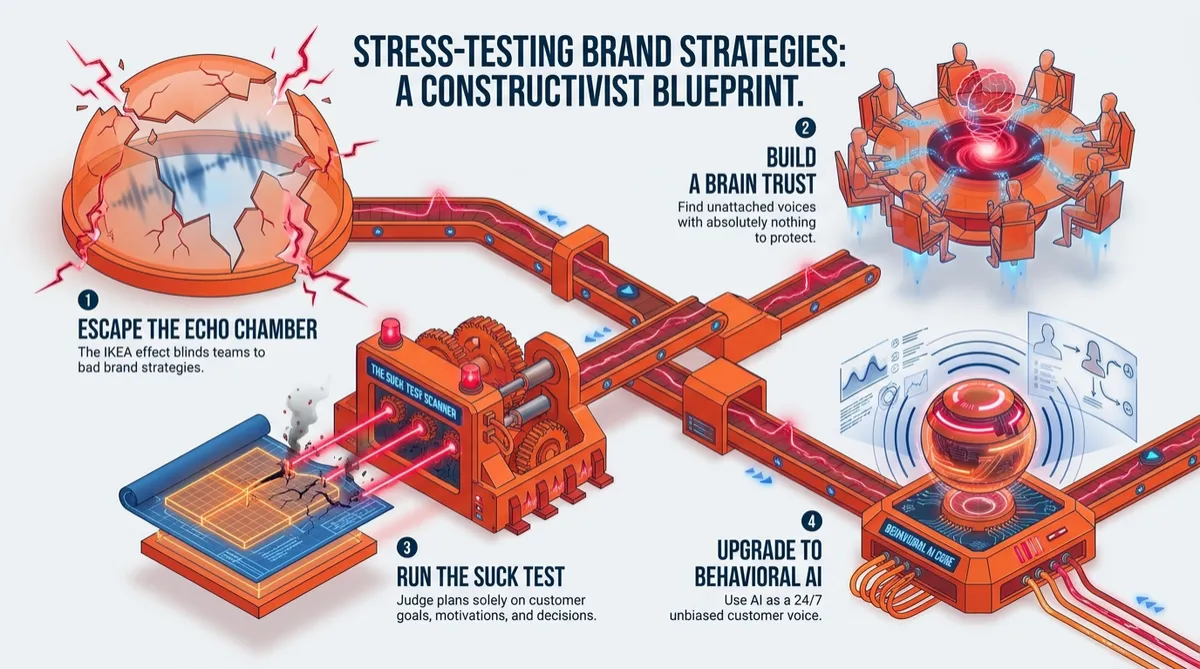
The Customer Brain Trust: Brand Strategy Stress Test
Executive Summary
Internal teams fall victim to a specific cognitive bias: The IKEA effect artificially inflates the perceived value of your own work. Without an independent voice, internal strategy reviews devolve into echo chambers rather than genuine stress tests.
Strategy must be filtered through a pure behavioral lens: You must evaluate every initiative strictly through customer goals, motivations, approach, and decision-making heuristics. If a plan solves a corporate P&L problem but ignores the consumer's subconscious mindstate, it will fail in market.
Effective stress-testing requires zero financial stakes: Implement an unattached "Brain Trust" tasked exclusively with finding where the plan fails the customer. This group must have no financial stake in the brand's outcome and no authority to rewrite the plan—only to expose its friction points.
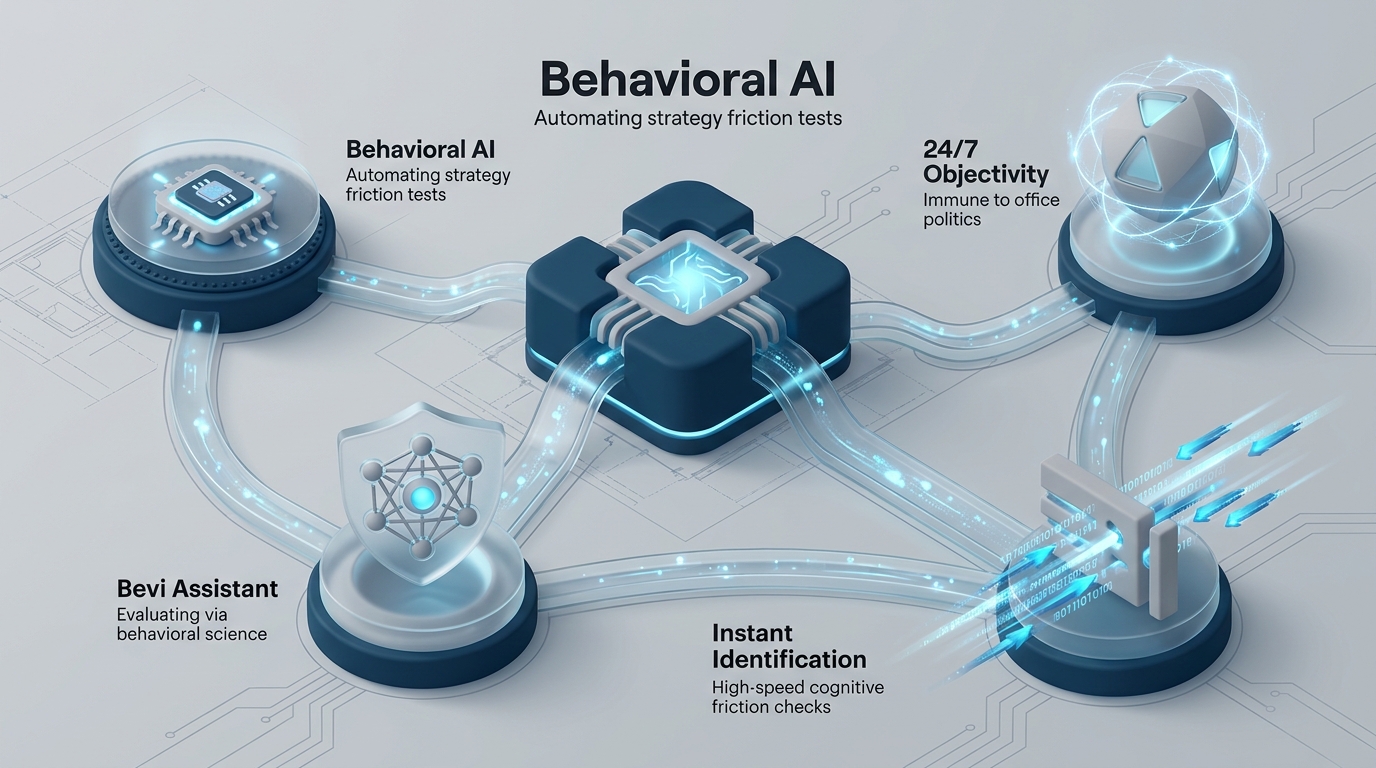
Behavioral AI eliminates corporate compliance pressure: Artificial intelligence acts as a 24/7 voice of the customer that is completely immune to office politics. By running campaigns through Bevi AI, Mindstate Group’s proprietary artificial intelligence assistant trained to evaluate marketing through behavioral science principles, you instantly identify cognitive friction before spending a single dollar on media.
The Strategic Shift
I want you to think about how you currently run a brand strategy review. You get the brand managers, the R&D team, the sales leaders, and market research into a room. You project a massive deck on the wall. You present your product innovations, your media spend, and your revenue forecasts.
Everybody nods. Everybody agrees. The plan gets approved.
And you know something? That entire meeting was a fake stress test.
It felt competitive. It felt rigorous. But it was an illusion. You were sitting in an echo chamber. Everyone in that room either helped build the plan or reported to someone whose bonus depended on that plan getting approved. There was a massive cost to compliance, and nobody wanted to look like the person failing the organization by pushing back.
The traditional way of building brand strategy relies on internal consensus. You socialize the deck. You get alignment. You build momentum. But momentum inside a corporate boardroom means absolutely nothing to the consumer staring at a grocery shelf.
The Customer Brain Trust approach strips the internal politics out of the equation entirely. You don't need more approvers on your strategy. You need an independent voice. You need a dedicated, merciless customer brain trust whose only job is to look at your plan and tell you exactly where it fails the behavioral reality of your buyer.
The Core Philosophy
To understand why smart brand teams launch spectacularly bad strategies, you have to understand the science of how we value our own ideas.
When you lock a group of intelligent marketers in a room to solve a revenue problem, ideas naturally start combining. You work late. You pressure-test assumptions. You build a complex strategy over the course of months.
And as you build it, a psychological heuristic takes over.
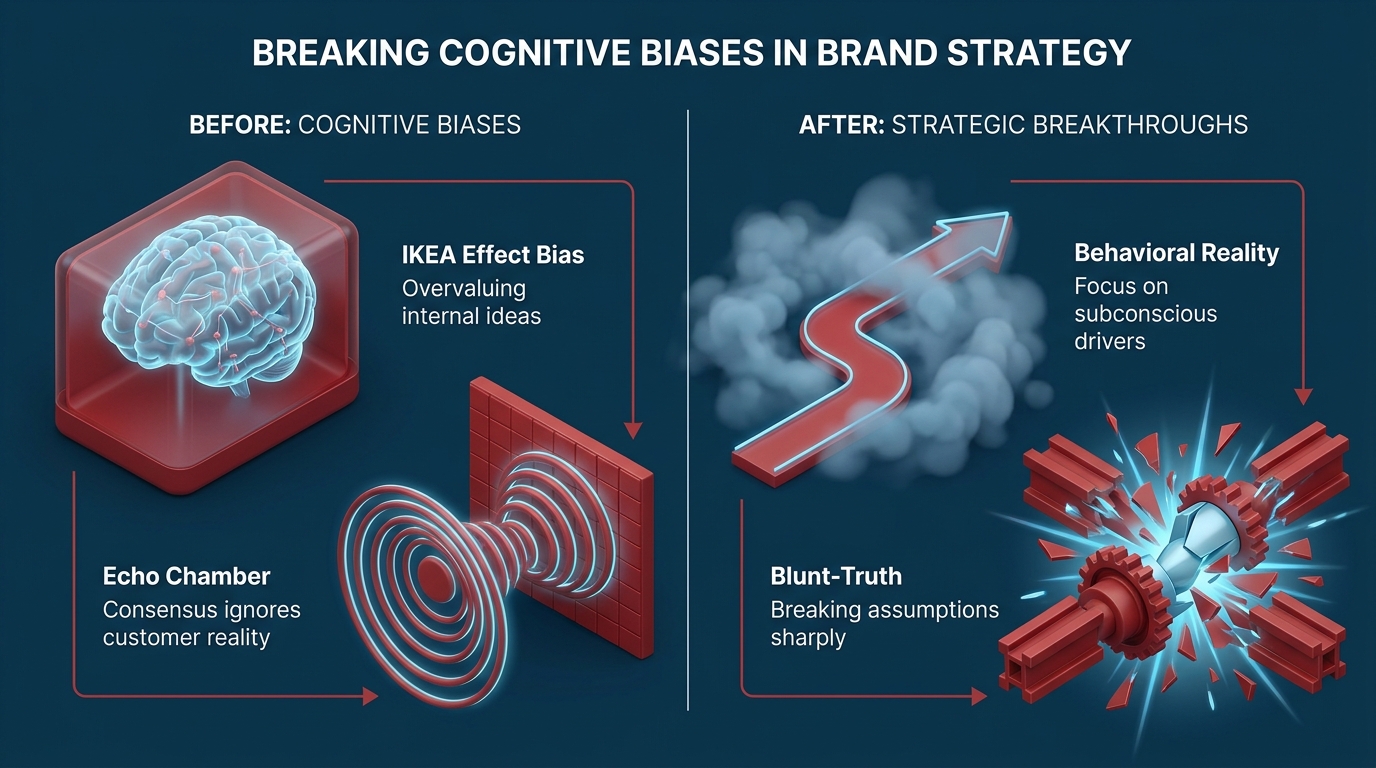
The IKEA effect is a cognitive bias that forces humans to assign disproportionately high value to things they build themselves. The more time, effort, and energy your brand team puts into a strategy, the more valuable and unquestionably correct you believe it to be.
This bias is dangerous. It becomes embedded in your professional identity. As outside feedback trickles in—even from actual market research—you automatically discount it. You write off the data because it contradicts this highly valuable, internally celebrated thing you just spent six months building.
"Everyone in the room is building the story just like everyone in the room was building the True North marketing plan." — Will Leach.
You start drinking your own Kool-Aid. You stop focusing on the customer's reality and start hyper-focusing on your own reality: hitting an arbitrary algorithm handed down by executives.
You need an unattached, blunt-truth mechanism to break the IKEA effect. You need someone wielding a sword to chop away at your assumptions.
The Implementation Blueprint
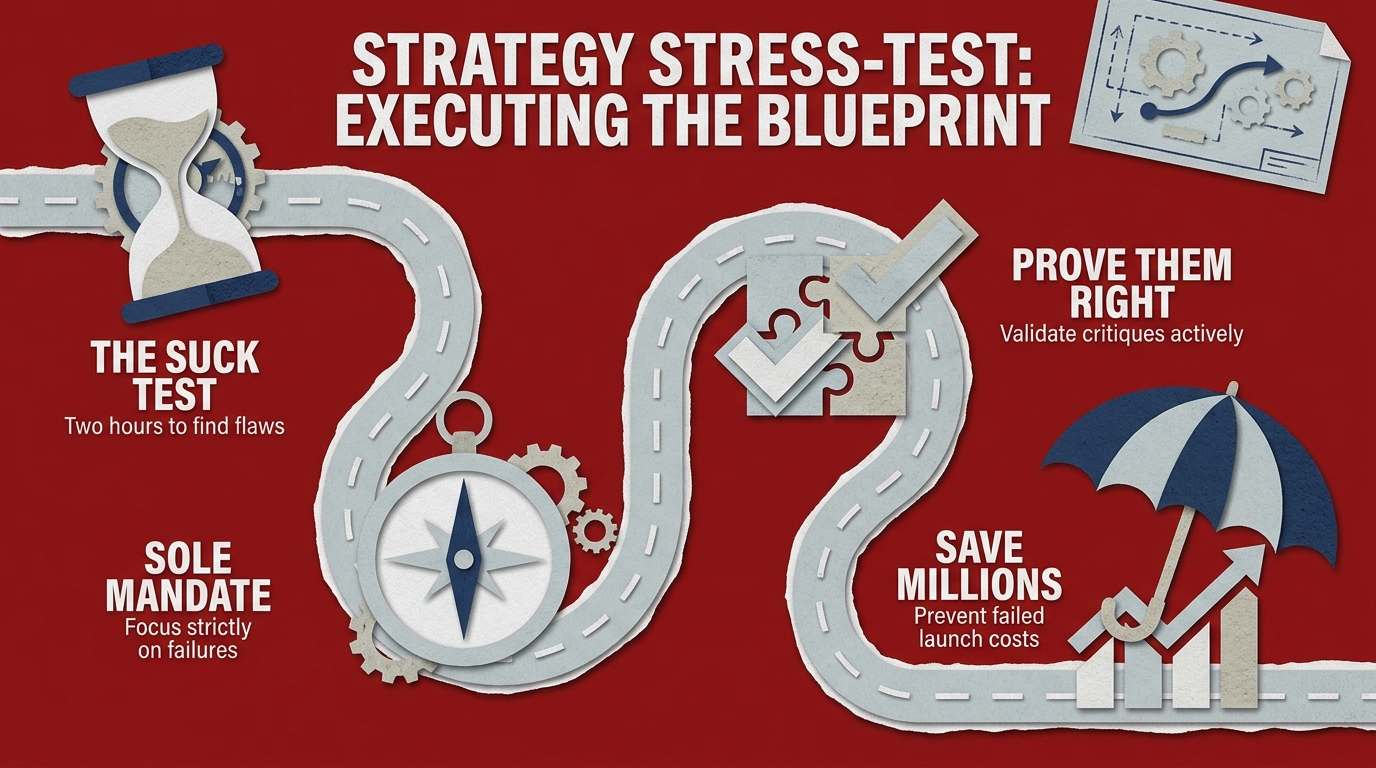
If you want to stop launching campaigns that look great in a deck but die in the market, you have to implement a systematic "Suck Test." Here is exactly how you build and deploy a customer brain trust to stress-test your strategy.
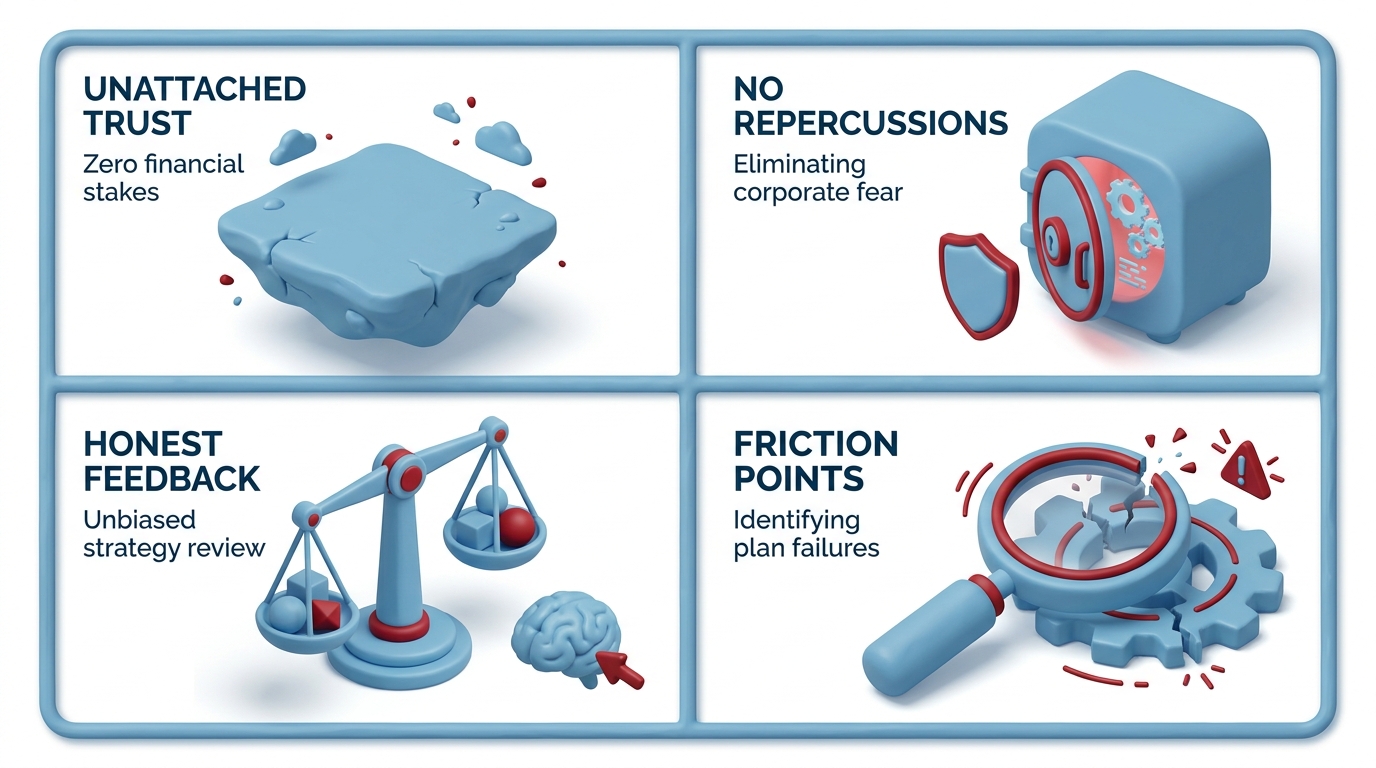
Build Your Unattached Brain Trust
The Action: Pick one or two people before your next planning review. That's it. Just one or two. But they must meet two non-negotiable criteria: They cannot have helped build the plan, and they can have zero accountability or financial tie to the brand's success.
Maybe it's a team member from an entirely different brand in your portfolio. Maybe it's someone from accounting. It doesn't matter. They just need to be entirely unattached to your bonus structure.
The Business ROI: You instantly eliminate the fear of corporate retaliation. People who need the brand to succeed will subconsciously twist logic to justify a bad plan. An unattached outsider won't.
"The problem was the pushback that we needed as a brand didn't come from us internally because we didn't want to look like we were basically failing the organization." — Will Leach.
Hand Them the Behavioral Lens
The Action: You do not hand this brain trust a P&L statement. You do not show them your media budget. You hand them one single sheet of paper detailing the consumer's behavioral reality.
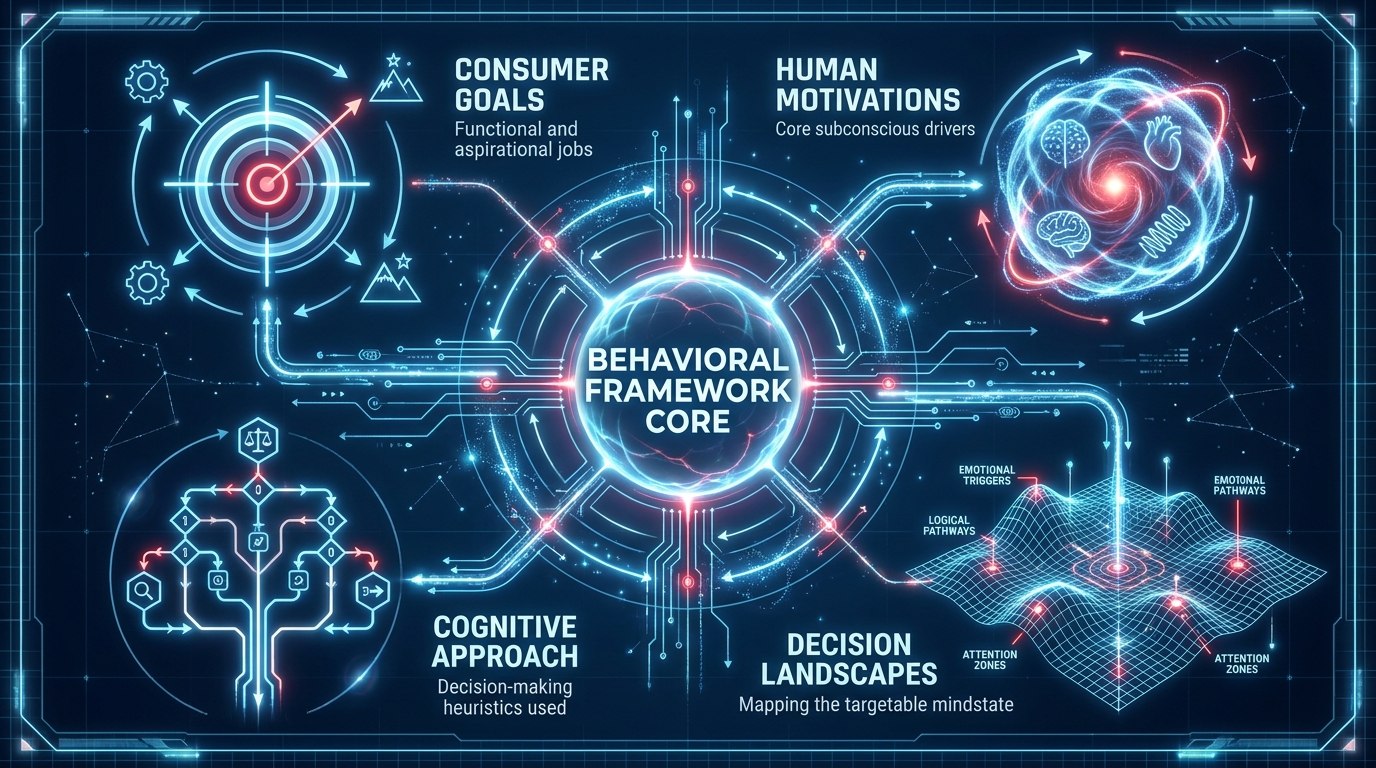
This requires understanding Mindstate Group's core triad of behavioral focus:
Goals: What is the specific job the consumer wants this category to do? What are their functional goals, and what are their higher-order aspirational goals?
Motivations: Which of the nine core human motivations is driving them? Are they seeking a feeling of success? Do they want to provide care to others? Are they looking for greater control over their environment?
Approach: How do they actually make decisions? What cognitive heuristics are they relying on?
This triad forms the foundation of what we map out using Decision Landscapes®, a proprietary visual framework that charts exactly how a consumer's subconscious goals and motivations intersect to form a targetable mindstate.
The Business ROI: You force the evaluation out of marketing theory and into behavioral science. The brain trust doesn't need to be consumer psychology experts. They just need to look at your creative and ask: Does this actually give the buyer a feeling of control, or are we just listing product features?
Run the "Suck Test" (And Prove Them Right)
The Action: Put your brain trust in a room alone with your brand plan. Give them two hours. Their mandate is not to tell you if they like the idea. Their sole mandate is to find exactly where the plan fails the customer.
Here is where the magic happens. When they come back and point out a flaw, your instinct will be to defend the work. Don't.
"Your job is to prove them right, not wrong, because if you can prove them right, you shouldn't move forward until you've had the ability to go back and rethink through the plan." — Will Leach.
The Business ROI: You kill bad ideas before they consume your budget. If you actively try to prove the critique right and realize the data actually supports your original plan, you proceed with massive confidence. But if you investigate and find they hit a nerve, you just saved your company millions of dollars in failed launch costs.
Automate the Friction with Behavioral AI
The Action: You don't always have the time or resources to pull internal outsiders into a room every time you iterate a concept. The modern upgrade is replacing the human brain trust with artificial intelligence.
You run your strategy through Bevi AI. You prompt the system with your customer's exact goals, motivations, and heuristics. Then you ask it to tear your strategy apart.
The Business ROI: Speed and absolute objectivity. AI doesn't care about your feelings. It doesn't care if you worked through the weekend to build the deck. It operates as a 24/7 voice of the customer that points out cognitive friction instantly.
Inside the Live Session
I know exactly what the cost of compliance looks like, because I lived it at Frito-Lay.
About fourteen years ago, I was a brand insights manager tasked with helping launch a new brand called True North. It was a peanut and nut-based snack aimed squarely at the health and wellness needs of baby boomers.
Look at the variables we were up against. We were launching a brand-new brand. We were targeting a new demographic we hadn't built products for before. We were using a new ad agency. We were dealing with a new product form that Frito-Lay didn't have much manufacturing experience with.
And on top of all that risk, executive leadership handed us a massive, aggressive revenue algorithm. True North was slated to be the anchor brand in a new health and wellness portfolio. We had to hit a massive financial number, and we didn't have time to do proper consumer testing to validate it.
We knew the goal was too aggressive. We knew the forecast was shaky. But when the larger organization needs you to meet a number, you get your marching orders. Pushing back makes you look like you're giving up. So we retrofitted our entire strategy to hit a fake revenue goal. We rushed innovations. We launched three different product lines to an untested consumer base.
Four years later, the business was sold off. PepsiCo publicly deemed it a failure compared to other adjacency wins we had in the portfolio—specifically Stacy's and Sabra.
I worked on Stacy's and Sabra too, so my entire track record isn't a disaster. But looking back at True North, I realize exactly what went wrong. We forced a strategy to fit an internal algorithm instead of a consumer mindstate. If we had an independent brain trust in the room—someone without their bonus tied to that revenue goal—they would have killed the plan in week one.
We didn't have the time to do traditional market research. But today, you can watch this exact methodology executed in real-time. In the Mindstate Group Implementation Masterclass, you can see how we apply these stress tests to actual brand collateral before a single media dollar is spent.
The Behavioral Imperative
Your competitors are sitting in echo chambers right now. They are high-fiving over strategy decks that satisfy their internal finance departments but entirely ignore the subconscious mindstates of their buyers.
They are crippled by the IKEA effect. You don't have to be.
Bringing an unattached perspective into your strategy planning isn't just a fun corporate exercise. It is a fundamental requirement for behavioral marketing. Whether you pull an outsider from another department or leverage behavioral AI to rip your assumptions apart, you must separate your brand's financial reality from your customer's psychological reality.
I'll leave you with this. Look at the strategy deck currently sitting on your desk. Who is the specific person in your organization who is allowed to stand up, point at that deck, and tell you it sucks?
If your answer is "nobody," your strategy is already in trouble. Go find that person. Hand them the behavioral lens. And let them do their job.